Best Roofing Material for Miami Homes: A Local Guide
Comparing metal, tile, flat, and shingle roofs to find the best roofing material for Miami homes, built for heat, salt air, and hurricanes.
Choosing the right roof in South Florida is a different decision than it is almost anywhere else in the country. Between the relentless heat, daily summer downpours, salt air drifting in off the coast, and the very real threat of hurricane-force winds, your roof has to work harder here than in most places. So when homeowners ask us what the best roofing material for Miami homes is, the honest answer is: it depends on your house, your budget, and your goals. There's no single "winner" for every property, but there is a right fit for yours.
At Gold Star Roofing, we've spent more than 14 years installing and repairing roofs across Miami-Dade and Broward County, from Hialeah and Doral to Coral Gables, Kendall, Homestead, and up into Fort Lauderdale and Boca Raton. This guide walks through the four materials we work with most so you can make an informed choice before you ever pick up the phone.
What Miami's Climate Demands From a Roof
Before comparing materials, it helps to understand what your roof is up against here. Any roofing material you consider should be judged on how well it handles four local realities:
- Heat and UV. Intense, year-round sun degrades materials and drives up cooling costs. Energy-efficient roofing can meaningfully lower your electric bill.
- Humidity and heavy rain. Frequent storms and standing moisture invite leaks, mold, and algae if a roof isn't properly sealed and pitched.
- Salt air. If you're near the coast, salt accelerates corrosion on metal components and fasteners, so material and finish quality matter.
- Hurricanes. This is the big one. Miami-Dade County enforces the strictest wind and hurricane building codes in the United States, and your roof has to meet them.
That last point is worth emphasizing. A roof installed to Miami-Dade specifications is engineered to survive conditions that would destroy a standard roof elsewhere. The right material, installed correctly and to code, is your home's first line of defense in a storm.
Comparing the Four Main Roofing Materials
Here's how the most common options stack up for a typical Miami home.
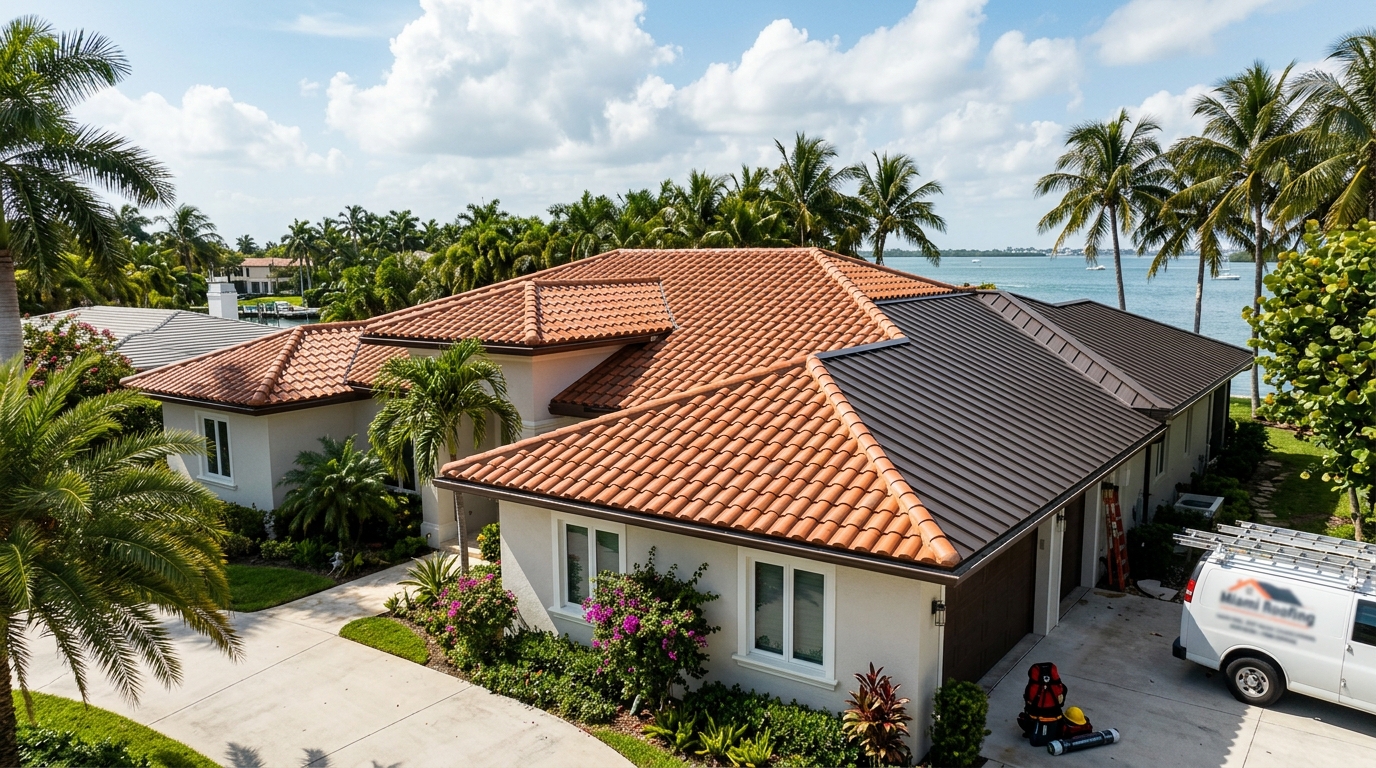
Metal roofing. Metal has become one of the most popular choices in South Florida, and for good reason. Standing-seam and metal roofs can be rated for 150+ mph winds, reflect a large share of the sun's heat for strong energy efficiency, and shed rain quickly. A quality metal roof can last 40 to 70 years. The main trade-offs are a higher upfront cost (often in the rough range of $10–$18 per square foot installed, depending on the system) and the need for corrosion-resistant finishes near the coast. For many homeowners, the long lifespan and storm performance justify the investment.
Concrete and clay tile. Tile is a Miami classic for a reason. It handles heat and humidity beautifully, resists rot and insects, and concrete tile can also be engineered to withstand 150+ mph winds. Properly installed tile roofs frequently last 50 years or more. The catch is weight: tile is heavy, so your home's structure needs to support it, and material plus labor typically run higher than shingles. Tile is an excellent match for Mediterranean and Spanish-style homes common across Coral Gables and the surrounding area.
Flat roofing (TPO and modified bitumen). Many Miami homes and most commercial buildings have flat or low-slope roofs, which need a specialized membrane system rather than tiles or shingles. TPO is a single-ply membrane with a reflective white surface that's great for energy efficiency, while modified bitumen is a proven, multi-layer asphalt-based system. Both are more affordable than metal or tile and are designed to handle ponding and heavy rain when installed with proper drainage. Expect a typical service life in the 15 to 25 year range, depending on the system and maintenance.
Architectural shingles. Asphalt shingles remain the most budget-friendly option and are widely used across Miami-Dade and Broward. Architectural (dimensional) shingles are thicker and more wind-resistant than the old three-tab style, and high-wind-rated products can perform well when installed to code. They're the lowest-cost choice up front, often the fastest to install, and easy to repair. The trade-off is a shorter lifespan than metal or tile, usually around 20 to 30 years in our climate, and they're less heat-reflective unless you choose a cool-roof rated product.
How to Match a Material to Your Home and Budget
With those options in mind, here's a practical way to narrow the field:
- If long-term value and storm resilience are your priorities, metal or concrete tile are hard to beat. Both carry high wind ratings and decades of lifespan.
- If you have a flat or low-slope roof, your real decision is between TPO and modified bitumen, not tiles or shingles. We'll help you choose based on slope, drainage, and budget.
- If upfront cost is the deciding factor, high-wind-rated architectural shingles deliver solid protection for less, with the understanding that you may replace them sooner.
- If your home's style or structure is a factor, tile suits classic South Florida architecture, while metal works on a wide range of modern and traditional homes.
Two more local factors are worth keeping in mind. First, Florida's "25% rule": if more than 25% of your roof is damaged or repaired within any 12-month period, the affected portion generally must be brought up to current code, which often means a full replacement rather than a patch. Second, the My Safe Florida Home program offers grants of up to $10,000 to help eligible homeowners harden their homes, including roof improvements that strengthen storm protection. And if your roof was damaged by a storm, a replacement may be covered by your homeowners insurance.
Frequently Asked Questions
What is the most hurricane-resistant roofing material for a Miami home? Metal and concrete tile are the strongest performers, with systems rated for 150+ mph winds. That said, wind resistance depends heavily on proper installation to Miami-Dade code, not just the material itself. A correctly installed high-wind shingle roof can outperform a poorly installed premium roof.
Will insurance pay for my new roof? It depends on the cause and your policy. Many storm-damaged roof replacements are covered by homeowners insurance, while normal wear and age usually are not. We provide free inspections, document the damage thoroughly, and help guide you through the insurance claim process.
How much does a new roof cost in Miami? Cost varies widely by material, roof size, slope, and condition of the existing structure. Shingles are typically the most affordable, with flat membrane systems in the middle, and metal or tile at the higher end. The most reliable way to get a real number is an on-site inspection and a written estimate.
Get a Free Roof Inspection From a Local Miami Team
The best way to find the right roofing material for your home is to have an experienced local team look at it. Gold Star Roofing is a family-owned, fully licensed, bonded, and insured contractor serving Miami-Dade and Broward County, and we offer free, no-obligation roof inspections. We'll assess your roof's condition, talk through your goals and budget, and give you an honest recommendation, with no pressure. Reach out today to schedule your free inspection and get a roof built for the way Miami weather really works.